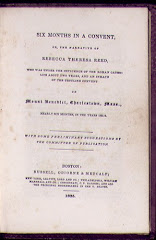
So...found this on GoogleScholar.com in the images gallery yesterday, and thought it was pretty cool. I looked all through ArtStor and couldn't find anything, even though I know there's a digitized painting of the riot floating around somewhere.
Monday, March 30, 2009

In Context...
Contextual Materials
Rebecca Reed’s “Six Months in a Convent” deals with two main issues. The first one is anti-Catholicism. In the Protestant antebellum America, Catholics were regarded with no small amount of suspicion. Perhaps rightly so; the Catholic Church is renowned for keeping its own council and its rituals secret, so misunderstandings have and do occur. The more paranoid of the antebellum conspiracy theorists worried that the Vatican had designs on taking over the government.
The second issue is not directly addressed in the novel but is an integral part of the public reaction and the falling-out of the burning of the Charleston, MA, Ursuline Convent on Mt. Benedict in 1834. Catholicism—more specifically, nuns and their convents—posed a threat to the American Protestant woman’s role in society, or true womanhood. Nuns chose to remain single, thereby rejecting the husband and children that defined the woman’s sphere, and had a remarkable amount of autonomy in the community for those times.
The documents below are gathered with the intent of helping a reader of “Six Months in a Convent” understand the text in the contexts of anti-Catholicism, true women, new women, nuns, and the riot. The materials are separated under category headings.
Anti-Catholicism:
1. Billington, Ray Allen. “Tentative Bibliography of Anti-Catholic Propaganda in the United States (1800-1860). The Catholic Historical Review, Vol. 18, No. 4 (Jan., 1933), pp. 492-513. http://www.jstor.org
2. Hofstadter, Richard. “The Paranoid Style in American Politics.” Harper’s Magazine, November 1964, pp. 77-86. http://www.zbths.org/1653109815561217/lib/1653109815561217/_files/Richard_Hofstadter.pdf
Hofstadter examines the history of the paranoid, conspiracy-theorist form of politics from the 1700’s to the twentieth century in America, including the anti-Masonist movements as well as anti-Catholicism. Anti-Catholic conspiracies include Maria Monk’s escaped nun tale, the belief of a Catholic-Protestant holy war sanctioned by Rome, priestly spies, and that the Pope and Europe seek to take over the government. This essay is important because these paranoid ideas were still thriving well in the nineteenth-century.
3. Griffin, Susan M. Anti-Catholicism and Nineteenth-Century Fiction. New York: Cambridge UP, 2004.
Griffin examines the role and form of Anti-Catholicism in nineteenth-century literature, as a genre. This might help a reader understand SMiaC better in regards to the genre of the anti-Catholic “escaped nun” tale.
True Womanhood:
1. Welter, Barbara. “The Cult of True Womanhood: 1820-1860.” American Quarterly, 18.2 (Summer, 1966), pp. 151-174. http://www.jstor.org
Welter’s “Cult of True Womanhood” explains exactly what the roles of nineteenth-century women were, the virtues ideal women were expected to possess, and the rationale behind them.
2. Roberts, Mary Louise. “True Womanhood Revisited.” Journal of Women’s History, 14.1 (Spring 2002), pp. 150-156. Academic Search Premier. http://ezproxy.lib.ucf.edu/login?URL=http://search.ebscohost.com.ezproxy.lib.ucf.edu/login.aspx?direct=true&db=aph&AN=6479854&site=ehost-live
Robert’s responds to Welter’s “Cult of True Womanhood” for not having a strong enough analytic framework, and briefly looks at the transition from the ideal True Woman to the New Woman of the late nineteenth and early twentieth-century.
New Womanhood:
Todd, Ellen Wiley. The “New Woman” Revised: Painting and Gender Politics on Fourteenth Street.
Berkeley: University of California Press, 1993. eScholarship Editions http://www.escholarship.org/editions/view?docId=ft9k4009m7;brand=eschol
This is an eBook that can be found freely over the web. The first chapter in particular will serve as a good outline for what exactly the New Woman is. After reading the essays on true womanhood, the scandal of SMiaC will become much clearer, as the inmates of the Ursuline Convent (including Reed herself) start to resemble more the New Woman than the True Woman.
Nuns:
http://www.CatholicNunsToday.org
A brief site about what exactly nuns and sisters are and do, the roles they fulfill in their communities, and a definition of their vows of chastity, poverty, and obedience. If I were editing a new edition of SMiaC, I would certainly make sure that the diverse roles of Catholic nuns and convents in the community were explained.
Charleston Convent:
"Burning of the Charlestown Convent," Boston Evening Transcript, 12 August, 1834.
http://www.yale.edu/glc/archive/949.htm
This site contains a transcript of the Boston Evening paper regarding the burning and fall-out of the burning of the Ursuline Convent in Charleston. The site is a part of the Yale “Gilder Lehrman Center for the Study of Slavery, Resistance, and Abolition.”If I were editing a new edition of SMiaC, I would definitely seek to include these papers.
Thursday, March 26, 2009
And the Hunt Continues
I'm not sure if I'll be using all the things that I've dug up--sources keep trickling in. One here, one there. I think I'm coming down with Academic Shiny Ball Syndrome/Kleptomania: "Oooh, that looks cool! *snatch*" Whether or not it may be useful, I grab it. 'Cause it's there, you know?
Anyway, here's a few more things that I have to wade through:
Billington, Ray Allen. “Tentative Bibliography of Anti-Catholic Propaganda in the United States (1800-1860). The Catholic Historical Review, Vol. 18, No. 4 (Jan., 1933), pp. 492-513. http://www.jstor.org
~This was something of a welcome find--and check out the dates on this thing! Anti-Catholic Propaganda 1800-60 in the title and the bib. was published in 1933. This made me feel like I found something good. :-)
Cohen, Daniel A. “Alvah Kelley’s Cow: Household Feuds, Proprietary Rights, and the Charleston Convent Riot.” The New England Quarterly, Vol. 74, No. 4 (Dec., 2001), pp. 531-579. http://www.jstor.org
~ I love Cohen. This is the 3rd or 4th article of his that I've found.
Hillery Jr., George A. “The Convent: Community, Prison, or Task Force?” Journal for the Scientific Study of Religion, Vol. 8, No. 1 (Spring, 1969), pp. 140-151. http://www.jstor.org
Pagliarini, Marie Anne. “The Pure American Woman and the Wicked Catholic Priest: An Analysis of Anti-Catholic Literature in Antebellum America.” Religion and American Culture, Vol. 9, No. 1 (Winter, 1999), pp. 97-128. http://www.jstor.org
I'm still working on contextual sources. Certainly "The Cult of True Womanhood" is one. Also up for consideration is
1. "An Answer to Six Months in a Convent" the Catholic return-fire to Reed's narrative, and
2. "A Review of the lady Superior's reply to "Six Months in a Convent" being a vindication of Miss. Reed" by Mary Edmond St. George, Sister.
Getting a hold of these looks like a pipe-dream, (especially since they are often in microfiche) but at least we know they exist.
Friday, February 13, 2009
Abstract
Amanda Ewoldt
Dr. Logan
LIT 6009
2 March 2009
True Womanhood and the Inmates of the Ursuline Convent
The first half of the nineteenth century saw a remarkable re-defining of women’s roles in society. Called True Womanhood, the literature and propaganda of the day extolled the duties and virtues held most dear to the antebellum American woman, who was trained to be a wife and mother: piety, purity, submissiveness, and domesticity. Women’s virtue was held above all else, and changes in society and alternate ways of life were considered to be a threat to the roles and “powers” of women. It is no surprise then, when the already fraying tensions between the Protestants and Catholics were further exacerbated by the convent life of the nuns. While the nuns were held to the same standards of virtue as the women on the outside, the facts that it was done in a single-sex community, away from the immediate influence of male authority, and that these women eschewed the “natural” roles of wives and mothers that made up the identity of the American woman, caused Protestants no small amount of anxiety. My aim for this paper is to analyze the characters of Rebecca Reed’s narrative Six Months in a Convent, with the purposes of discovered whether or not these women were indeed “True Women” or precursors to the “New Woman.”
In order to accomplish this, I will study the historical context of the events around the destruction of the Ursuline convent, the definitions of True Womanhood, and female autonomy. Within this social-historical context, the text of the Six Months in a Convent, especially the prefatory matter, will be examined closely in the light of the times. The letters and even the very narrative are singular instances of a woman stepping outside of True Womanhood by engaging in a public controversy and defending herself—actions which risked her already tenuous hold on gentility, and had to be explained away by her (male) supporters in a preface to the text. Furthermore, there is a suggestive parallel between the Protestant women who chose to stay spinsters because they felt a higher calling of service (missionary work, etc.), and the women who chose to join a religious order of nuns for the same reason. Spinsters were trying to overcome the stigma attached to their unmarried status, but as mentioned before, anything that shook up the status quo was seen as an attack on female virtue.
Rebecca Reed, a disadvantaged girl with an incomplete education and no prospects turned to the convent with the hopes of finishing her education and being able to support herself. Women at that time had few career options, seeing as how they were confined only to home and hearth according to True Womanhood. Becoming a nun was one such way of escaping abject poverty, learning a skill, and finishing her education. Understanding the framework of the times is integral to understanding what really happened and why. It is easy to judge a work like this from a modern feminist perspective so as to cast the players in the drama as either a hero or a villain. There is more to the situation and these people than black-and-white stereotypes. Understanding the broader framework makes understanding the text much easier.
Abstract
Amanda Ewoldt
Dr. Logan
LIT 6009
22 February 2009
Cohen, Daniel A. “The Respectability of Rebecca Reed: Genteel Womanhood and Sectarian
Conflict in Antebellum America.” Journal of the Early Republic, Vol. 16, No. 3 (Autumn, 1996), pp. 419-461. http://www.jstor.org/.
The Respectability of Rebecca Reed: Genteel Womanhood and Sectarian
Conflict in Antebellum America
In this essay, Daniel Cohen investigates Rebecca Reed’s involvement with the burning of the Ursuline Convent of Mt. Benedict. He defines the antebellum ideals of “respectability” and “gentility,” and applies them to the history and character of Reed, in an attempt to uncover the truth of the narrative Six Months in a Convent. Respectability denotes “laudable moral or religious character and conduct,” whereas gentility denotes a person’s manners and style of living—especially that of dress (424).
Reed met heavily with public criticism with her narrative, and any validity that she might have had was dismissed by historians. One of the reasons for this was that her credibility was hurt with the subsequent publication of the Maria Monk’s similar narrative, Awful Disclosures. Monk’s tale was later debunked (421). In the controversy that followed the destruction of the Convent, Reed’s respectability and pretentions to gentility came under fire, especially as she defended herself publicly—something that a True Woman would be loathe to do (425). Cohen refrains from making any judgments until all the facts of the “case” were discussed, but holds that the unorthodox Rebecca Reed was a cagey opportunist who used her networking skills to further her education and improve her station in life.
Cohen examines the biographical details given in Six Months in a Convent against the documented facts of census returns, probate records, city directories, and unpublished Catholic records and correspondence, as well as published articles (421). By using this information, he is able to look at both accounts of the story, pinpoint the commonalities, and frame the issue in the bigger social issues of female respectability and decorum.
A brief synopsis is as follows: according to Reed, she was welcome to the Ursuline establishment and visited the Superior often. The Catholics of the community, the Superior of the Convent, and the Bishop, courted her earnestly against the wishes of Reed’s Protestant family (433-36). After her admission to the Order, she began to resent the asceticism of convent life. Believing that there were plans to kidnap her and take her to a convent in Canada, she escaped and sought refuge with a Protestant family. The Superior of the Ursuline took a different view of the situation, as she had reservations of the suitability of Reed for the convent. The girl was disadvantaged, shiftless, and relentless (437-40). By the time that Reed effected her escape, they had already decided to throw her out. In addition to these opposing viewpoints, Cohen lays out the ensuing public controversy that both Reed, the Superior, and their respective followers engaged in.
The essay is remarkably eye-opening. First person narratives are notoriously untrustworthy, especially if the prefatory matter asserts the truth and virtue of the author. In Cohen’s essay, the real Rebecca Theresa Reed was revealed—not as the poor victim as her narrative assumes nor as the villainess the public labeled her—but as a bright young woman in a disadvantaged position. She had few prospects but a strong enough presence of mind and few scruples when it came to playing the Protestants and Catholics off against each other. Cohen’s essay would be useful in other projects having to do with women in the nineteenth century, the meaning of True Womanhood, and the tricky ways that women had to use when walking the delicate line of propriety. It would also be useful in research having to do with the history of American sectarian rivalries between Catholicism and Protestantism.
Food for Thought:
This essay was an absolute gold mine. Not only did it explain the situations plainly, but it gave me a hefty wish-list of reading material. I had been unaware that the Superior had written an Answer to SMIC. Now that I know, it would be prudent for me to see if I could track it down. That way I would have two sets of evidences in front of me so I could compare and contrast for myself. It appears that Cohen may also have written a book on the topic. I want to track that down as well.
I love footnotes; they’re awesomely helpful if you pay attention to them.
I liked Cohen’s style of writing. When I’m properly engaged and able to use my brain, my style closely resembles his. He gathers the information and lays it out in a clear manner that the reader can follow with ease. It makes for a more interesting “dialogue” between writer and reader—the reader can follow along with the writer and is able to make leaps of logic and connections at the same time. He also seems to be rather noncommittal—he lays out the facts as they are, points out the inconsistencies, asks questions, and then proceeds to answer them with more information. The reader is mainly left to make up their own mind, rather than having any one particular view shoved at them. It’s an unusual tactic in a field which is so adamant about making an argument and then backing it up. He did the opposite. He gave the evidence, and then made a reasonable claim. I like that. It’s less intimidating.
More Research...
Had some extra time, so I went looking under some more rocks...
More search terms:
~anti-Catholic Narratives
~19th Century Women's Writing
~Irish Catholic
~Runaway Nuns
I have also discovered that google.scholar.com is a good mine for articles, dissertations and honors papers, books, and book chapters. Copyright is sometimes problematic, but often there is enough in the preview to be able to tell if a source is worth my time or not.
2 new sources that I found:
Griffin, Susan. “Women, anti-Catholicism, and narrative in nineteenth century America.” The Cambridge Companion to Nineteenth-Century American Women’s Writing. Ed. Bauer, Dale M. and Philip Gould. Cambridge: Cambridge University Press, 2001. 157-175.
This one is still under copyright, obviously, but I'm going to try to find it through the library system so I can read the entire chapter 7.
Berman, Cassandra N. “Wayward Nuns, Randy Priests, and Women’s Autonomy: “Convent Abuse” and the Threat to Protestant Patriarchy in Victorian England.” Diss. Macalester College, 2006. http://digitalcommons.macalester.edu/cgi/viewcontent.cgi? article=1000&context=reli_honors
Monday, February 9, 2009
Preliminary Bibliography
Search terms:
~Six Months in a Convent
~Escaped nuns tales
~Nuns
~Rebecca Reed
~Convents
~Anti-Catholicism
Preliminary Bibliography:
Cohen, Daniel A. “The Respectability of Rebecca Reed: Genteel Womanhood and Sectarian Conflict in Antebellum America.” Journal of the Early Republic, Vol. 16, No. 3 (Autumn, 1996), pp. 419-461. 9 February 2009. http://www.jstor.org/.
Cohen takes a chronological and historical look at Reed’s SMIC Narrative. He looks at the social climate of the times, Reed’s family background, and examines multiple accounts of her admission into the Convent.
Griffin, Susan M. “Awful Disclosures: Women’s Evidence in the Escaped Nun’s Tale.” PMLA, Vol. 111, No. 1, Special Topic: The Status of Evidence (Jan., 1996), pp. 93-107. 9 February 2009. www.jstor.org.
Griffin explores the “escaped nun” tale as a genre. She notes the commonalities of narration themes: torture, murder, rape, and etc. She also posits that the genre is related to the gothic, that the structures of the fictional and nonfictional accounts all have claims toward the truth, complete with footnotes and other references designed to make the reader believe in the truth and accuracy of the claims. Further, she looks at the women themselves, and the social ramifications of coming forward with their tales.
Fessenden, Tracy. “The Convent, the Brothel, and the Protestant Woman’s Sphere.” Signs, Vol. 25, No. 2 (Winter, 2000), pp. 451-478. 9 February 2009. www.jstor.org.
The article explores the interconnection of the convent, brothel, and Protestant women. She makes the point that convents made people nervous because they were so private. Prostitutes had an all-too-public image, whereas no one really knew what the nuns got up to in their cloisters. Both groups of women endured the same mistrust and antagonism by the Protestants, overshadowed by the enormity of Rome and their moral imperatives. Still, Fessenden remarks that nuns had an almost feminist influence: they were able teachers, could support themselves, and defied social mores by taking the veil rather than husbands and families.
McCauley, Bernadette. “Their Lives Are Little Known: Nuns and American Reform.” Prospects, Vol. 29 (2004), pp. 219-229.
Not entirely sure if this is something that will be useful, but I have ordered it through Interlibrary Loan. Its description states that the article is about nuns’ influence on American social reform in the nineteenth and twentieth centuries, including reform and educational reforms. Also discussed is the issue that nuns operate outside of normal female parameters.
Food for Thought:
I rather liked digging up articles that had a social/historical standpoint. I’ve never been one to believe entirely in the text itself—and frankly, as soon as someone tells me that they are a good person, I tend to get suspicious. In any case, this was fun. It is sort of like detective work—I get to essentially run a background check on the author, look at the case that was built against her, and pick it all apart. Good fun.
Maybe I missed my calling.
In any case, I am not sure exactly where I want to take my research project, yet. I still feel as though I am in the info-gathering stage. I still have to read the novel in its entirety, but that shouldn’t take long as it is a quick read, and in large print. Then I have to read it all over again. As I research other articles and whatnot, a second reading will help me to look for any more interesting dirt to dig in and ideas to pick at.
Subscribe to:
Posts (Atom)